By Ted Clifford
In August, UNC Health Pardee celebrated the opening of a 23-bed adolescent mental health unit. Dozens of people crowded into the future dayroom; standing against walls painted carefully chosen tones of soothing blue and green and sitting in chairs that are too heavy to lift, or throw. The opening of the facility was a milestone — the culmination of a nearly year and a half long project to address an urgent shortage of mental health resources in western North Carolina.
But before the ribbon was cut, Dr. Greg McCarty, Pardee’s chief medical officer, had more news to share: The day before Pardee had officially been granted Level III Trauma Center status.
The news was greeted with cheers.
“I can’t tell you what a need this is,” McCarty said. “Now we’re going to be able to provide this not just for western North Carolina, not just for Henderson, but for the whole state and the region.”
The trauma center designation and the new mental health unit are both signs of just how far Pardee has come. What began as a 26-patient community hospital in 1913 has grown into a 222-bed facility that remains under local control while having access to the vast resources of the University of North Carolina’s health system.
Today, Pardee is positioning itself as a significant player in western North Carolina’s increasingly competitive health care market that’s long been dominated by a single system, Mission Health, and its centerpiece, Asheville’s Mission Hospital.
Throughout its history, Pardee hasn’t tried to compete with Mission directly. But while western North Carolina grows, and Mission’s reputation suffers while its services contract in the wake of its 2019 acquisition by Nashville-based HCA, Pardee has seen an opportunity.
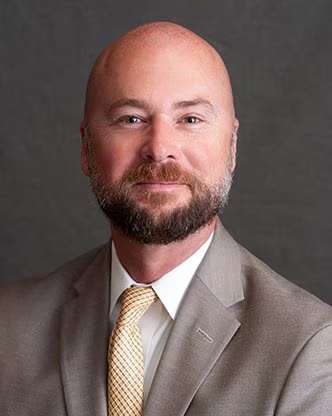
“It’s fair to say that we saw that many people in the region were seeking a clinically excellent option elsewhere,” said John Bryant, vice president of operations at Pardee. “We had the opportunity to really grow and excel and ensure that that option was available to as many people as possible.”
There are some signs that Pardee has made inroads into Mission’s market. In 2019, Pardee provided health care services to 12,973 Buncombe County residents. By 2025, that number had risen to 20,981 Buncombe County residents, a roughly 60 percent increase.
The hospital has also focused on expanding services in areas where Mission traditionally excelled. A cancer center added in 2016 was recently augmented with a new infusion center. Earlier this year, Pardee opened a new medical office in Brevard, in neighboring Transylvania County, which is also home to Mission Health’s Transylvania Regional Hospital. Pardee is also striking out further north, building a new medical office in Mills River.
In July, Pardee received the Lantern Award from the Emergency Nurses Association, in recognition of innovations in its emergency department. The federal Centers for Medicare & Medicaid Services also awarded Pardee a five-star rating. The agency’s highest rating, it is only awarded to 12 percent of hospitals nationwide. Mission Hospital, by comparison, has a three-star rating.
“We want you to have access to the highest quality care, regardless of what the service is, as close to where you live as possible. That’s the gold standard,” said Bryant.
Community in their DNA
Pardee began as Patton Memorial Hospital in 1913, a 26-patient facility staffed by five physicians. Like when Mission was created in Asheville, women in the community raised funds for the new hospital by selling flowers.

In 1953, Pardee as we know it was founded as a county-owned hospital. A new 70-bed facility was constructed, in part through a $100,000 gift from Margaret R. Pardee, who the hospital was later named after.
More funds were raised by local businessmen, including Henderson County Commissioner Rebecca McCall’s grandfather who joined in the effort to build a new facility after his first wife died of sepsis at the old Patton Memorial Hospital.
Over the next six decades, Pardee continued to grow. Around 2010, the board of directors began exploring options to expand its resources and operations while maintaining local control. The result of that was a management agreement signed with UNC Health in 2011. UNC Health took over the day-to-day running of the hospital and folded the facility into its network.
But Pardee remained 100 percent owned by the residents of Henderson County. That’s “probably the core part of our DNA,” said Bryant.
The difference compared with the sale of Mission to HCA nearly a decade later was that no one was in a panic to sell, said William Lapsley, chairman of the Henderson County Board of Commissioners, who served as the head of the hospital’s board of directors at the time.
Instead, Lapsley said that the agreement was driven by a belief that Pardee was doing well and had the capacity to grow, especially in areas like oncology, neurology and cardiology. At the time, many residents of Henderson County had to travel to Mission Hospital to get specialty care.
“Why couldn’t we provide those services rather than people going out of town?” Lapsley said.
Tying into the UNC Health system meant access to a far deeper pool of resources. Providers can call specialists in Chapel Hill to consult on cases, and best practices are shared across hospitals to make them more efficient. Part of the appeal was also to get a better deal with insurers like Blue Cross Blue Shield, who offer better reimbursement rates to larger hospital systems.

But retaining local control has also created a clear sense of pride and “buy-in” from the residents of Henderson County.
“That small town community hospital feel is often important,” said Marc Malloy, founder of healthcare consulting firm Sevenya and a fellow at the Western North Carolina Health Policy Institute. “In Henderson, they have a hospital that is owned by the county, I think that creates a certain feeling of connectivity.”
“It truly is a community hospital, and I hope it stays that way,” said McCall, who was born at Pardee and gave birth to her first child there. “It’s a special place for us.”
David vs. Goliath?
There’s no escaping the comparison with Mission. The former nonprofit is the dominant health care player in western North Carolina. Not only is it the only Level I trauma center in western North Carolina, Mission also has an unusually large regional footprint.
Prior to its acquisition by HCA, Mission had been allowed to establish itself as a monopoly in the region under the condition that it submit to state oversight. But after lobbying efforts by then-CEO Ron Paulus, the North Carolina state legislature agreed to lift this requirement.
Regional competitors to Mission were historically confined to specific geographic areas that they served. But in recent years, Mission Hospital has rolled back services in surrounding counties and seen declines in core specialties like oncology and emergency medicine.
“Pardee recognized an opportunity,” Bryant said. Today, Pardee sees more opportunity to address an unmet need for high quality care in a range of specialties. “We had the opportunity to really grow and excel and ensure that that option was available to as many people as possible.”
While the long-term goal is to grow Pardee throughout western North Carolina, leadership acknowledges the difference in scale with Mission. Last year, Pardee saw about 35,000 visits to its emergency room. Mission saw 110,000.
According to data from the Centers for Medicare & Medicaid Services, in 2025 Pardee discharged 8,251 patients who spent a total of 33,308 inpatient days at the hospital. During the same period, Mission discharged 50,611 patients who spent a total of 274,745 inpatient days.
While Pardee has grown considerably in the last 15 years, it has not closed the gap with Mission. In 2011, Pardee had employed and contracted with 238 physicians. Today it employs 370, according to a spokesperson, while Mission employs over 1,000, according to documents submitted to the Department of Health and Human Services.

While Pardee might see that it has space to compete with Mission for services, you’re unlikely to see the hospitals going head-to-head fighting for patients.
“It’s not like car dealerships,” Malloy said. For hospitals, he said, any expansion or change in services or pricing is potentially a commitment of tens or hundreds of millions of dollars. It requires long-term planning that takes into account everything from a region’s expected demographic changes to future changes in Medicare and Medicaid reimbursement rates to understand what a community can actually support in terms of demand for health care.
As a result, Malloy says, Pardee’s expansion is better understood as a long-term strategic realignment to find areas it can expand than an attempt to undercut Mission.
“It’s a focus on ‘what does the community need? Where can we grow?’ And then as any system grows, that creates a more diversified portfolio of capabilities. It increases that scope and scale and allows you to do more,” Malloy said.
Some worry that growth for the sake of growth could destroy what makes Pardee special.
“Once you get too big you lose what it is that made you who you are,” said McCall. “A good example of that is Mission Hospital: It used to be the premier place to go… but in the past few years it’s been disappointing some of the things we’ve seen since its takeover by a major corporation. Some of the values have been lost.”
But if Pardee continues to grow, it is likely to find a receptive audience. Problems at Mission and the perception that the administration and corporate owners have done little to address those concerns mean that many are enthusiastic about competition for medical services.
“I think it’s clear that HCA is responsive to competition. In markets where there are other trauma centers their hospitals seem to perform better,” said Aaron Sarver, a spokesperson for Reclaim Healthcare, an Asheville nonprofit that advocates for health care access and changes at Mission Hospital.
In Brevard, Mayor Maureen Copelof said she is “pleased” to see Pardee expand its services. While Copelof agreed that more competition across the board was better for residents, she said that Pardee’s local focus made it special.
“A health care facility reflects the corporate culture and theirs is very patient-focused. A lot of the leadership is from the local area, and they understand that the medical facility is part of a community, not just a corporation that is out to make money.”
Asheville Watchdog is a nonprofit news team producing stories that matter to Asheville and Buncombe County. Ted Clifford is The Watchdog’s investigative reporter focusing on healthcare. He can be reached at tclifford@avlwatchdog.org.
KEEP UP WITH THE LATEST